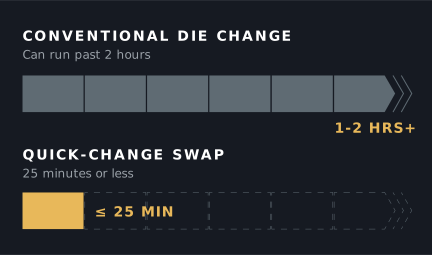
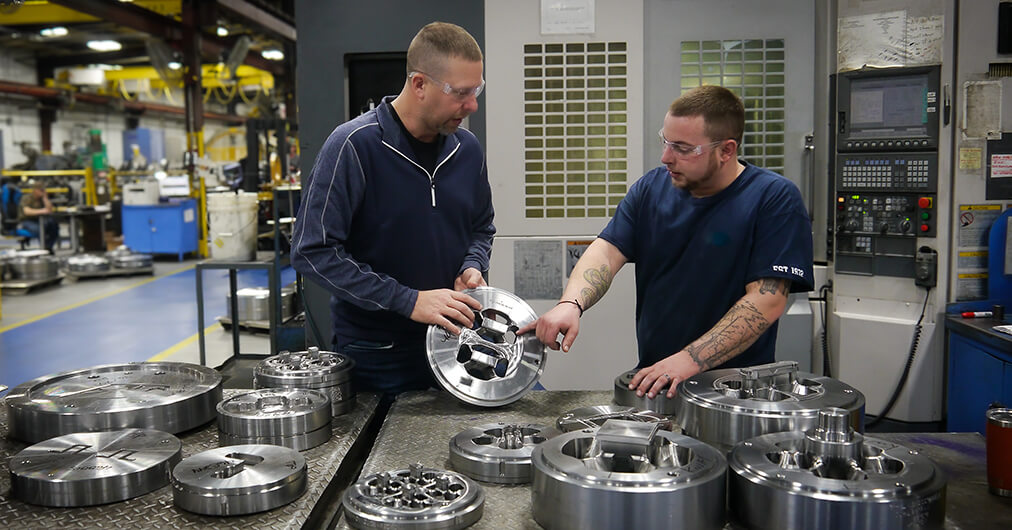
A conventional die change can run past two hours, and the press forges nothing the whole time. Quick-change tooling moves that work off the press. Dies are set up in cassettes at the bench, then go into the press as one assembly. Changeover takes 25 minutes or less.
The bolster stays in the press. The cassette assembly comes out in one piece and the next set goes in, typically in under 25 minutes on presses up to 4,000 tons.
The First Part Is a Good Part
Dies are shimmed to exact, repeatable stack heights before they ever reach the press. When the cassette goes in, the first part off the press is a good part.
Wear Items Swap Out
The backstop, locating key, and clamp shoes are all replaceable. Threaded holes use replaceable inserts, eliminating the need for weld repair or a helicoil for stripped threads.
Where the Time Goes in a Conventional Die Change
On a conventional setup, the top die goes in first, usually on a fork truck. It’s awkward work and it’s dangerous. The top die gets clamped, then the bottom die is driven in and clamped, and the tooling still has to come up to heat before the press runs.
That routinely takes over an hour and can run past two. Larger presses with heavier dies take even longer because there’s no automated help moving them.
Every minute of it is press time.
How a Quick-Change System Works
The bolster stays in the press. Upper and lower cassettes have pockets that hold the dies in exact position, and the two load into the machine together, located by a key. A cassette can hold round dies, rectangular dies, or a mix, and the system runs on forge, trim, and coining stations.
The slow work happens offline while the current job keeps running. Dies are shimmed to exact, repeatable stack heights at the bench, so the set that goes into the press is already right. The next cassette set preheats while the current one runs, so it’s ready the moment the change starts.
Watch a Quick-Change Swap
The video below walks through a full cassette change at the press, step by step. Notice how little downtime there is. Setup and preheating already happened offline, so the press only waits on the swap itself.
At the press, changeover runs in this order:
01
Raise the ram to top dead center and support the upper cassette so the dies can’t touch when the press is jogged down.
02
Remove the bottom cassette clamps. Swing the top cassette clamps out; they stay attached to the bolster.
03
Back the press up to top dead center and lift the cassette assembly out with a forklift fixture.
04
Bring in the preheated replacement set and reverse the sequence.
The worn set goes back to the bench for resinking, off the press.
Resinks Without Resetting the Press
A die loses height every time it’s resunk. In a quick-change cassette, a matching die height shim goes under the resunk die and restores the stack, so setups remain repeatable from the first sink to the last.
That only works if the die was designed to be re-cut in the first place, with replaceable shims underneath. All wear components such as locating features and clamps are replaceable too.
Design the die to be re-cut.
The Cost Savings of a Faster Changeover
Our customers report, on average, that downtime costs about $2,000 an hour. Those same customers running quick change report an average savings of about $650 per die change. That adds up to $100,000 or more saved per press, per year.
Quick change has moved forging efficiency from about 65% to 80%. It pays in high- and low-production shops alike. A shop that used to run one set of dies for a day and a half before changing over can run five small jobs in a day instead.
Your own number depends on your downtime rate and how long a change takes today. Shorter changes make shorter runs pay.
Avg Saved Per Changeover
~$0
Per Press, Per Year
$0+
Forging Efficiency
65%→0%
“
As it relates to set up time, quick change tooling usually reduces the time from about two hours to 15 to 20 minutes.
Terry McInerney
Forging Operations & Tooling Consultant
Sizing Quick-Change to Your Press
Quick-change systems are rated for presses up to 4,000 tons. They aren’t typically recommended for larger presses, though some shops do run them there.
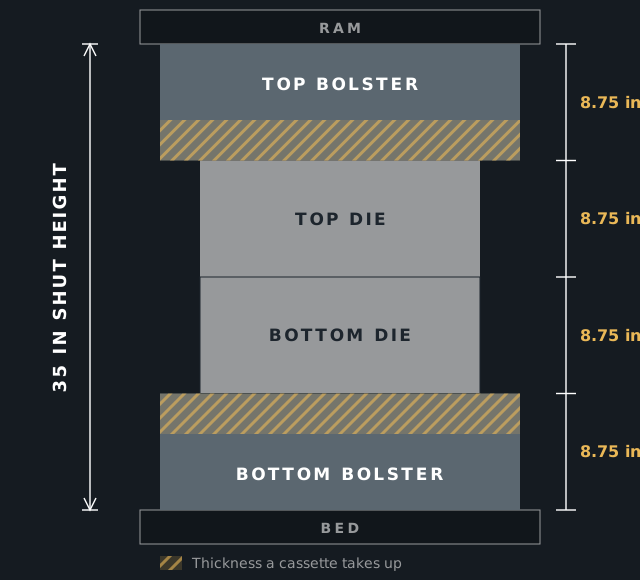
Cassettes use up some bolster thickness, so plan the stack from the shut height down. A sound starting point is to divide shut height by four. A 35 in shut height gives 8.75 in each for the top die, bottom die, top bolster, and bottom bolster. Cassettes, die locks, and long parts all eat into that, so keep die thickness at 6–8 in, even when the die is recessed into a cassette.
Every robust die starts with what fits inside the shut height.
Bolsters still need their minimum thickness. Below it, they flex under load and lose tolerance within a few hundred cycles.
Press capacity
Minimum bolster thickness
500–1,000 ton
3 in
1,300–2,000 ton
4 in
2,500–3,500 ton
5–6 in
4,000 ton+
7–9 in
case study
Quick Change Tooling: 60% Longer Die Life and 83% Reduction in Changeover Time
A conventional die change can run past two hours, and the press forges nothing the whole time. Quick-change tooling moves that work off the press. Dies are set up in cassettes at the bench and shimmed to exact stack heights, then go into the press as one assembly. The change takes 25 minutes or less.
Gemini Group’s forge tooling team designs and builds quick-change bolsters, cassettes, and dies for presses up to 4,000 tons. Send over your usable ram and bed space along with open and shut heights, and let’s talk about what quick-change would look like in your press.
We’ve spent decades helping forgers across the country enhance tool performance and improve operational efficiency, and we want to help you, too. Learn how to eliminate wasted time, money and other precious resources in our free e-book written by experts, for experts.